Aerodynamics & Flight Principles
Angle of Attack Explained: Lift, Stalls, and Pilot Awareness
Understand the angle that connects wing geometry, relative wind, lift production, and aerodynamic stalls—and why neither pitch attitude nor airspeed tells the whole story.

Angle of attack is one of the shortest definitions in flight training and one of the easiest ideas to misunderstand. A student may memorize “chord line and relative wind,” then return to the cockpit and judge stall margin mainly from nose position or airspeed. Those cues matter, but neither is the definition of AoA.
That distinction has practical value. It explains why an airplane can be nose-high without being stalled, why an accelerated stall can occur above the familiar straight-and-level stall speed, and why adding power is not a universal substitute for reducing AoA. This guide builds the concept step by step, using simplified diagrams for education rather than aircraft-specific operating data.
1. What is angle of attack?
Angle of attack (AoA) is the angle between a wing’s chord line and the relative wind. The chord line is an imaginary straight line from the leading edge to the trailing edge of an airfoil. An airfoil is the cross-sectional shape of a wing, blade, or other lifting surface.
The relative wind is the airflow relative to the aircraft or lifting surface. In the standard simplified model, it is parallel to and opposite the flight path through the surrounding air. Local flow near a real wing can be influenced by the wing itself, propeller slipstream, and other surfaces, but the basic chord-line definition remains the starting point for pilot education.
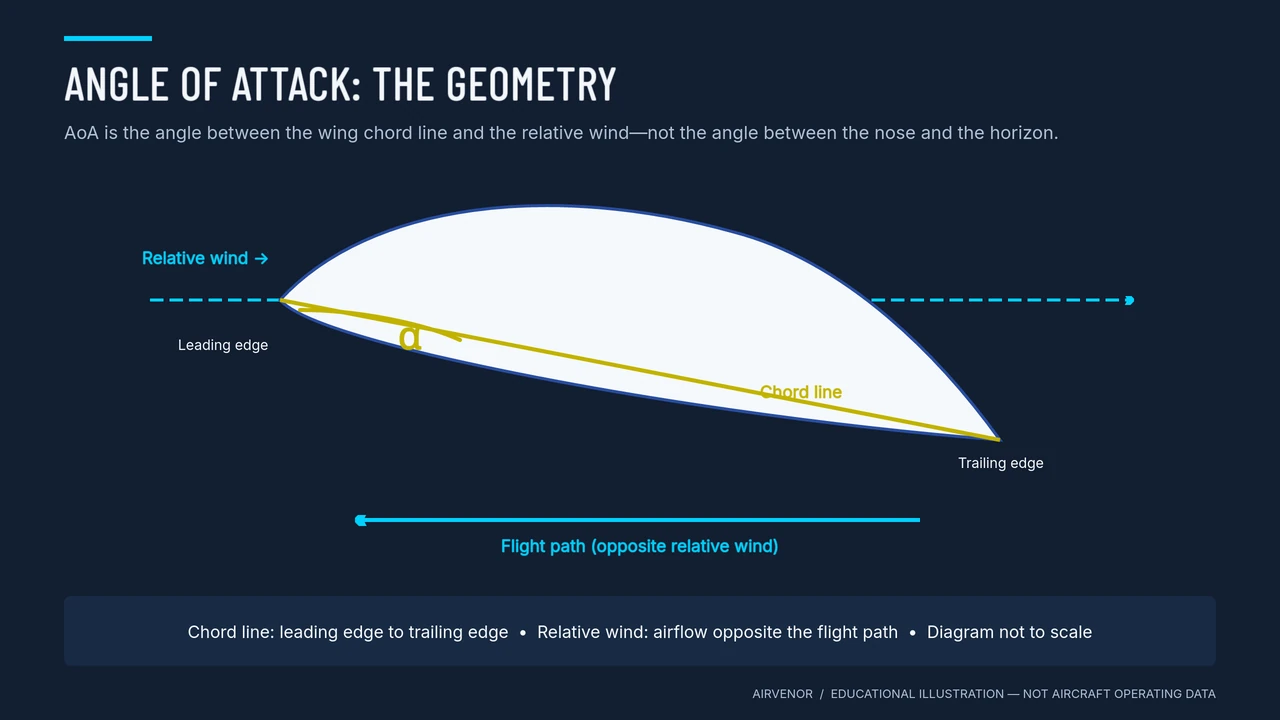
AoA is an aerodynamic angle, not a direction of travel
An aircraft has a pitch attitude, a flight path, and an angle of attack, and these are not interchangeable. Pitch attitude describes the aircraft’s orientation relative to the horizon. Flight path describes the direction in which it is traveling through the air mass. AoA connects the wing’s reference line to the airflow it encounters.
A useful mental model is: pitch attitude tells you where the nose points; AoA tells you how the wing meets the air.
2. Angle of attack versus pitch attitude
Imagine three simplified flight conditions with the same nose attitude: a climb, level flight, and a descent. Because the flight path differs in each case, the relative wind also differs. The wing can therefore meet the air at three different angles even though its orientation to the horizon has not changed.
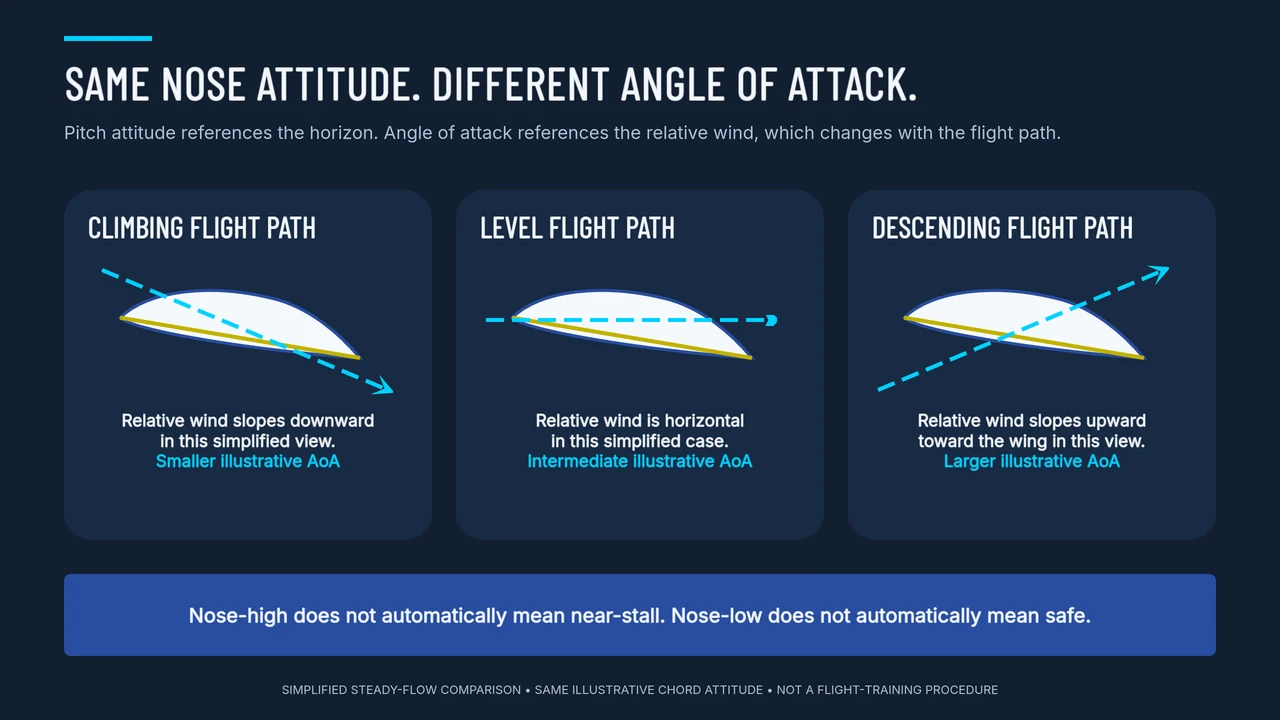
This is why a high nose attitude is not absolute evidence of an impending stall. Some aircraft can climb steeply at a modest AoA. Conversely, an airplane can exceed critical AoA while its nose is level or below the horizon, particularly during an abrupt maneuver or an accelerating flight-path change.
The relationship also works in the other direction: a pilot’s normal pitch reference during approach is valuable, but it does not remove the need to monitor airspeed trends, configuration, coordination, and aircraft-specific cues. AoA is not “invisible” because it is unimportant; it is easy to overlook because most basic cockpits do not display it directly.
3. How angle of attack affects lift
Lift is the aerodynamic force perpendicular to the relative wind. A wing creates lift through its interaction with the airflow, involving pressure distribution and turning of the flow. No single slogan about wing shape or equal transit time adequately explains the complete physics.
For a simplified subsonic model, lift can be expressed as:
Here, L is lift, ρ (rho) is air density, V is true airspeed, S is wing reference area, and CL is the lift coefficient. The equation is a model for understanding relationships, not a substitute for the performance data in an AFM/POH. For a separate guide to speed references, see indicated airspeed, true airspeed, and groundspeed explained.
AoA enters this relationship primarily through CL. Over a useful range for a given wing configuration, increasing AoA increases CL in an approximately linear way. That is why, with other factors unchanged, a moderate increase in AoA increases lift. It is also why slow, level flight generally requires a higher AoA than fast, level flight: the reduction in dynamic pressure must be balanced by a higher lift coefficient if total lift is to remain the same.
CL and CLmax
CL is dimensionless: it is not an angle, a force, or an airspeed. It represents how effectively a particular wing condition generates lift for the existing dynamic pressure and wing area. Airfoil design, flap setting, wing geometry, Reynolds number, and surface condition can change the relationship between CL and AoA.
CLmax is the maximum lift coefficient on that curve. The AoA at which the curve reaches this peak is called the critical or stalling angle of attack. There is no universal degree value that applies to every airplane and condition.
4. Critical angle of attack and the aerodynamic stall
As AoA increases, the airflow has more difficulty following the wing’s upper surface. Separation within the boundary layer grows, the lift curve begins to round over, and drag characteristics change. At the critical AoA, CL reaches CLmax. Beyond that point, a further increase in AoA reduces CL for that wing condition: the wing is stalled.
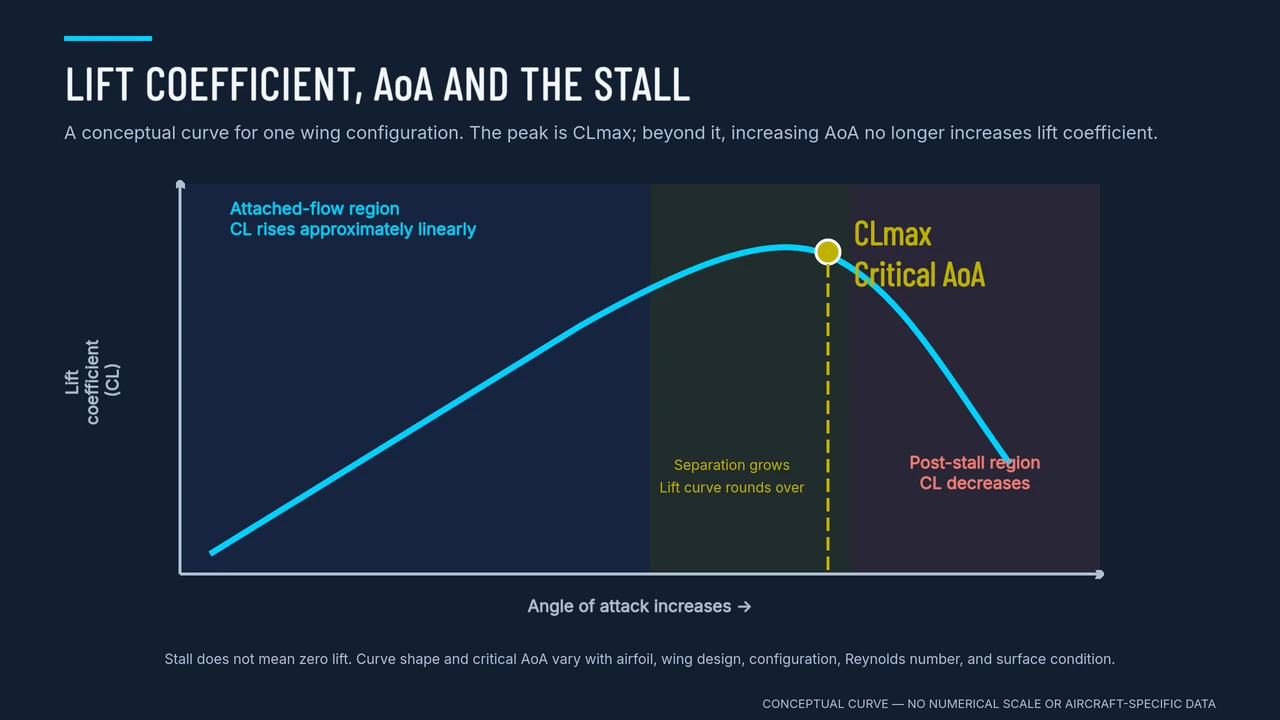
A stall therefore does not mean that the wing instantly produces zero lift, that the engine has stopped, or that the airplane must be pointing steeply upward. It is an aerodynamic condition associated with exceeding the wing’s critical AoA and losing further lift-coefficient growth with increasing AoA.
The FAA’s Airplane Flying Handbook emphasizes that the direct cause of every stall is excessive AoA and that low speed is not necessary. An excessive AoA can be imposed at different airspeeds, attitudes, and power settings. Aircraft-specific stall behavior and recovery still vary, so pilots must use approved documentation and qualified instruction rather than treating a generic diagram as a procedure.
5. Why stall speed is not a fixed number
A published stall speed applies to stated conditions, which may include weight, center of gravity, configuration, power, coordination, and load factor. Change those conditions and the indicated airspeed at which the wing reaches critical AoA can change too—even though the fundamental stall definition has not changed.
Load factor and accelerated stalls
Load factor is the ratio of the aerodynamic force supporting the aircraft to its weight in the simplified pilot-training model. During a coordinated level turn, the wing must support both the vertical requirement and the force associated with turning. Maintaining altitude therefore requires more total lift than in wings-level flight.
For the same weight and configuration, stall speed increases approximately with the square root of load factor. In an ideal coordinated level turn at 60° of bank, load factor is 2. The corresponding stall speed is therefore about √2, or 1.41, times the 1G reference value. This is a mathematical relationship, not a recommended operating target or a replacement for actual aircraft limitations.
An accelerated stall occurs when critical AoA is reached at a speed above the relevant unaccelerated reference because maneuvering increases the required lift. An abrupt pull-up can produce the same basic problem. The airspeed indicator may show a value comfortably above the familiar 1G stall speed, yet the wing can still be stalled.
Weight, CG position, flap setting, ice or other contamination, and aircraft design also matter. High-lift devices can change CLmax and the shape of the lift curve; contamination can degrade the wing’s aerodynamic behavior. Always use the current AFM/POH and operating procedures for the specific aircraft and conditions. For related performance context, read AIRVENOR’s guide to density altitude.
6. Developing stall-margin awareness
Stall-margin awareness means understanding how close the wing may be to critical AoA, not merely remembering one airspeed. Pilots integrate several sources of information:
- Aircraft cues: buffet, control feel, nose or roll behavior, and changes in response can be relevant, but their character varies by aircraft.
- Warnings: horns, lights, stick shakers, and other systems depend on the installed design. Not every warning device measures AoA in the same way.
- Flight condition: configuration, load factor, coordination, weight, CG, power, and recent control inputs provide essential context.
- AoA indication: when installed and properly calibrated, an AoA indicator can provide a more direct representation of stall margin. Its display logic and limitations are aircraft- and system-specific.
At the first indication of a stall, the fundamental aerodynamic objective is to reduce AoA. The FAA describes forward elevator input as required to reduce AoA, coordinated control use, and power adjustment as necessary in its general training guidance. That is not permission to apply one identical sequence to every aircraft: automatic systems, swept-wing characteristics, multiengine considerations, and approved procedures can change the required response.
Intentional stall and upset training belongs in a structured lesson with a qualified instructor, an appropriate aircraft or training device, and current approved procedures. A simulator can help explain relationships and rehearse decision-making, but a desktop simulation does not automatically reproduce an aircraft’s real stall behavior. AIRVENOR’s pilot-training roadmap provides a broader training framework.
7. Common misconceptions about angle of attack
“A stall happens when the airplane gets too slow.”
Low speed can lead to increasing AoA, but speed itself is not the defining cause. Exceeding critical AoA is.
“Nose-high means the wing is stalled.”
Pitch attitude and AoA use different references. Flight path and relative wind must be considered.
“A stalled wing makes no lift.”
The lift coefficient decreases beyond CLmax; it does not necessarily become zero.
“Power alone cures every stall.”
Power may be needed in a recovery, but the wing cannot leave the stalled condition without an appropriate reduction in AoA. Aircraft-specific procedures govern the complete response.
“Critical AoA is always the same number of degrees.”
There is no universal value across wings, configurations, and surface conditions. Even for one aircraft, pilots should use approved data and installed-system guidance.
8. Practical takeaways
- Define AoA using chord line and relative wind, not the horizon.
- Treat pitch attitude, flight path, airspeed, and AoA as related but distinct concepts.
- Use CLmax to understand the peak of the lift curve and critical AoA.
- Remember that stall speed is conditional; load factor and configuration can change it.
- Read stall speeds alongside their stated AFM/POH conditions.
- Respond to actual training and warnings according to the specific aircraft, not a generic memory aid.
- Use diagrams to understand principles, then validate operational knowledge with approved documentation and instruction.
9. Frequently asked questions
Can an airplane stall at high airspeed?
Yes. A sufficiently high AoA can be imposed during maneuvering at speeds above the familiar 1G stall speed. Structural and operating limits still apply; this is a concept to understand, not a maneuver to experiment with outside approved training.
Is angle of attack the same as deck angle?
No. Deck angle generally refers to the aircraft body’s inclination relative to a reference such as the horizon. AoA refers to the wing chord line relative to the airflow. Wing incidence and flight-path direction mean the angles need not match.
Does lowering the nose always recover a stall?
The universal aerodynamic requirement is to reduce AoA, and forward elevator input is commonly required. The necessary control input and complete recovery depend on the aircraft, attitude, installed systems, and situation. Follow the AFM/POH and qualified instruction.
Do flaps change critical angle of attack?
Flaps and other high-lift devices change wing geometry and the lift curve, including CLmax and stall characteristics. The exact effect and approved operating speeds are aircraft-specific.
Does an AoA indicator replace airspeed monitoring?
No. It adds stall-margin information; it does not replace airspeed, attitude, configuration, energy management, or operating limitations. Pilots must understand the installed indicator’s calibration and display logic.
10. Conclusion: the essential lesson
Angle of attack is the bridge between wing orientation and the airflow that produces lift. Pitch attitude describes where the nose points; airspeed describes one part of the aircraft’s energy state; neither alone defines stall margin. The wing stalls when it exceeds critical AoA, at the peak of its lift curve, not when a universal nose position or airspeed appears.
Keep the distinction clear and several other topics become easier to understand: slow flight, steep turns, accelerated stalls, high-lift devices, approach control, and upset prevention. For every operational application, return to the specific aircraft’s approved documentation and current training guidance.